Origin of Life on Planet Water - Index
Spontaneous Generation - The Primeval Soup
Panspermia - Life Hitched a Ride to Earth from Space
=>> Evolution Pathway and Links to the Climate and Atmosphere
Evolution of Planet Water
The First Forms of Life
Evolution of Life as We Know It
How Plants Change the Atmosphere
Is There Life Elsewhere ?
Evolution of Life Pathway and Links to the Climate and Atmosphere
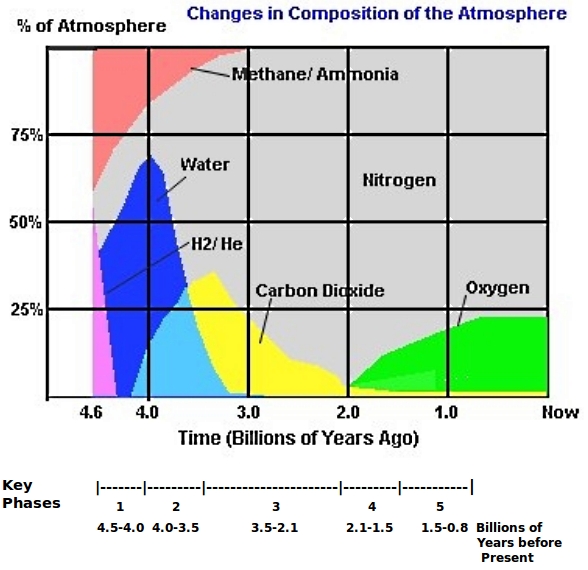
The Presumed History of the Atmosphere
Composition of Gases from Modern Volcanoes and Modern Planet Water
(Note: Lot of Guesses and presumptions here)| Phase | First | Second | Third | Fourth | Fifth( Modern ) |
| Period – Billions of years before present | 4.5-4.0 | 4.0-3.5 | 3.5-2.1 | 2.1-1.5 | 1.5-0.8 |
| Gas | |||||
| Water Vapour | 5% | 60% | 10% | 5% | 0-4% |
| Nitrogen | 1% | 3% | 60% | 65% | 78% |
| Carbon dioxide | - | 20% | 5% | 1% | 0.04% |
| Oxygen | - | - | - | 5% | 21% |
| Hydrogen | 35% | 1% | |||
| Helium | 35% | ||||
| Methane/ NH3 | 21% | 10% | |||
| Sulphur dioxide | |
0.0001% |
The five key phases in the development of the atmosphere were:
Primitive Atmosphere - Soon after the Planet formed
4.5 Billion Years ago
The first atmosphere on the hot molten sphere contained hydrogen, helium, methane and water.
The Hydrogen and Helium molecules were too light to be retained and were lost into space.
The surface was hot and unstable. There were none of the modern features on earth such as
the crust, oceans or atmosphere.
Second Atmosphere formed out gassing of volcanoes once the crust stabilized
4.0 - 3.5 Billion Years ago
This was a period of intense volcanic activity after the crust stabilized and the primitive
oceans began to form. Presumably the atmosphere at this time mirrors the composition of
gases released from modern volcanoes.
Water, Carbon Dioxide and Nitrogen were dominant, with sulphur dioxide, carbon monoxide,
ammonia, methane and hydrochloric acid also present. As the earth cooled the water vapour
condensed to form the first oceans, which may have formed in episodes due to the
bombardment from meteorites, comets, etc.
Composition of Gases from Modern Volcanoes and Modern Planet Water
Primitive Atmosphere - Soon after the Planet formed
4.5 Billion Years ago
The first atmosphere on the hot molten sphere contained hydrogen, helium, methane and water. The Hydrogen and Helium molecules were too light to be retained and were lost into space. The surface was hot and unstable. There were none of the modern features on earth such as the crust, oceans or atmosphere.
Second Atmosphere formed out gassing of volcanoes once the crust stabilized
4.0 - 3.5 Billion Years ago
This was a period of intense volcanic activity after the crust stabilized and the primitive oceans began to form. Presumably the atmosphere at this time mirrors the composition of gases released from modern volcanoes.
Water, Carbon Dioxide and Nitrogen were dominant, with sulphur dioxide, carbon monoxide, ammonia, methane and hydrochloric acid also present. As the earth cooled the water vapour condensed to form the first oceans, which may have formed in episodes due to the bombardment from meteorites, comets, etc.
Composition of Gases from Modern Volcanoes and Modern Planet Water
| Gas | Hawaiian Volcanoes | Present Atmosphere of Planet Water |
| Water Vapour | 79% | 0-4% |
| Carbon dioxide | 12% | 0.04% |
| Sulphur dioxide | 7% | 0.0001% |
| Nitrogen | 1% | 78% |
| Oxygen | 21% |
The loss of water vapour may have increased the relative concentration of carbon dioxide to as high as 80% and also increased the relative nitrogen level.
Third Atmosphere - Carbon dioxide level falls - it dissolves in the condensing water & precipitates.
3.5 - 2.1 Billion Years ago
The carbon dioxide level falls as it dissolves in the condensing water and precipitates and becomes sequestrated in the cooling oceans. The carbonic acid formed reacts with Calcium and Magnesium silicate rocks to yield Calcium carbonate (limestone) and Magnesium Carbonate (Dolomite). This locking up of carbon dioxide reduces its level in the atmosphere.
CaSiO3 + CO2 <=> CaCO3 + SiO2
Fourth Atmosphere - Build-up of oxygen in the atmosphere
2.1 - 1.5 Billion Years ago
Oxygen which has been present in only trace amounts for 2.5 billion years, begins to build-up in the atmosphere.
Some oxygen formed through photo-dissociation of water vapour:
2H20 => 2H2- + O2
However most of the oxygen was probably produced as a by-product of photosynthetic autotrophs using light energy to split water molecules and so build organic compounds. Primitive unicellular forms resembling modern blue-green algae (cyanobacteria) released oxygen, which accumulated in the atmosphere and was deposited in iron oxide beds on the floor of the ocean. Other primitive bacteria such as the purple bacteria, contain simplified photosystems that do not release oxygen. Recent research has suggested that that non-oxygen-producing bacteria species such as the purple and green bacteria are the most ancient photosynthetic bacteria.
Another group of non-oxygen-producing bacteria, known as heliobacteria, evolved later and appear to have been the precursors of the forms that produce oxygen as a byproduct. The heliobacteria appear to be the most closely related to the common ancestor of the oxygen-producing photosynthetic cyanobacteria.
Relatives of cyanobacteria appear to have given rise to chloroplasts in algae and green plants - the chloroplasts are the small bodies in plant cells that carry out photosynthesis in modern algae and other plants. This occurred through a process of engulfment where these primitive cyanobacteria were captured, engulfed and enslaving by other cells to become the solar driven carbohydrate factories within the cells.
Chloroplasts contain their own RNA and are thought to have been derived from cells which were once independent.
A similar process is thought to have involved the engulfing and enslavement of other bacteria to form mitochondria - the energy powerhouses of cells using oxidative phosphorylation to use oxygen and carbohydrate to release energy, carbon dioxide and water.
These complex cells with organelles entrapped within them, and nuclei became the 'eukaryotes' - the next stage in were in evolution of unicellular organisms. In some ways these forms can be regarded as the first type of 'multi-cellular organism' - though they are not generally recognized as such. The organelles represent cells within cells.
It was the power of this organization, and more complex and adaptable structure which led to the explosion of types and species. The higher efficiency of aerobic respiration and the development of photosynthesis for generating new complex molecules to feed upon was also crucial for this expansion.
The oxygen that was produced was toxic to most forms present at the time and its build-up may have cause the first mass extinction on the planet opening up new habitats and opportunities for eukaryotes respiring oxygen.
These changes in the atmosphere and structural organization led to the 'explosion of life" in the Cambrian geological period (570-500 million years ago) - see next section.
Fifth Atmosphere - Final phases is developing the modern oxygen rich atmosphere
1.5 - 0.8 Billion Years ago
The final phase of development of the modern atmosphere was the removal of the last remnants carbon dioxide (from 1-5% down to 0.04% today) and the build-up of oxygen to modern day proportions (from about 10% ? to 21% today).
Recent research has suggested that an earlier spread of plants onto the vacant land surfaces may have cause this, perhaps supported by the development of a protective ozone layer. This final phase of the changes in the atmosphere may have been responsible for the dramatic cooling of the earth and the intense glaciations that took place from 700 t0 580 millions of years ago that heralded the Cambrian explosion of life.
For this to occur plants would have had to develop 300 millions years earlier than previously thought.
An article published in Science suggest that land plants may have developed at 700 million years ago, much sooner than the 480 million year date, and that land fungi may have developed 1.3 billion years ago. This article suggests that land plants and fungi may have caused the Snowball earth - the cooling of the Earth's temperature that preceded the Cambrian Explosion of Life. The suggestion is that the abundant plants would have removed the remaining remnants of carbon dioxide and increased the amount of oxygen to the level needs to support aerobic organisms.
The proposed process is a reversal of the global warming we see today, where the release of more carbon dioxide by humans is triggering a greenhouse effect and increasing earth's temperature.
Fossil evidence suggest that bacteria formed microbial mats on land as early as three billion years ago.
Fossilized remnants and other biochemical evidence from South Africa suggest that photosynthetic bacteria (primarily blue-green cyanobacteria may have colonized the wet surface of clay-rich soil during rainy seasons, but were blanketed by aerosol deposits laid down during subsequent dry seasons.
Such mats may have formed in surface pools, water edges, and other wet spots on land.
Comparison with atmospheres on other Planets in the Solar System
The table below shows that the Earth's atmosphere is very different from that of Mars Venus. This is partially explained by the effect that living things have had on Earth's atmosphere. The high oxygen level is particularly anomalous given its high reactivity. Perhaps only living things can sustain it.
The climate, atmosphere and life are intimately entwined on Planet Water.
Comparison of Atmosphere and Surface Temperature and Moisture on Earth, Mars and Venus
| Phase | Venus | Mars | Earth |
| Water Vapour | - | 0.03% | 0-4% |
| Nitrogen | 3% | 3% | 78% |
| Carbon dioxide | 96% | 95% | 0.04% |
| Surface Temp. (deg C) | 460 | -113 to 0 | 15 |
| Surface Pressure (bar) | 90 | 0.01 | 1 |
>> Next See Evolution of Planet Water >>